Most business owners look at Google as a digital lottery system. They publish a website, write a few articles, cross their fingers, and hope the search engine forces their name to the top of page one. When their website remains hidden on page three or four, they blame bad luck or assume search algorithms are completely unpredictable.
But search engines are not mysterious guessing games. They are highly sophisticated, predictable computer systems running on mathematical logic, technical data standards, and user experience signals.
If you want your business to dominate organic search results and capture high-intent leads 24/7 without burning thousands of rupees on paid advertising, you need to understand exactly how the engine under the hood operates.
As an independent organic growth consultant based in Hisar, Haryana, I treat search mechanics like a precise clinical science. Drawing from my professional background in paramedical diagnostics before dedicating my career full-time to marketing technology, I analyze search systems like a diagnostic checkup. Let’s break down exactly how modern search engines function—and how they have radically transformed in the age of artificial intelligence.
The Three Classic Pillars of Search Mechanics
Every major search engine—whether it is Google, Bing, or Yahoo—historically relies on a three-stage sequential pipeline to process information:
1. Crawling: The Digital Discovery Phase
Search engines deploy automated software programs called “bots,” “spiders,” or “crawlers” to constantly scan the internet. These crawlers discover new and updated content by moving from link to link across the web. If your website has messy underlying source code, broken internal link structures, or an unoptimized robots.txt file, crawlers will get trapped and leave. If a bot cannot discover your page, you simply do not exist to the engine.
2. Indexing: The Global Virtual Library
Once a bot crawls a page, the search engine parses the data—analyzing the text, images, code structure, and overall meaning. If the page passes quality standards, it is added to a massive, global digital storage base called the Index. Think of this as a highly organized library containing billions of web pages.
3. Ranking: The Mathematical Valuation Loop
When a user types a query into a search box, the engine doesn’t scan the entire live internet; it queries its index. In a split second, it evaluates hundreds of distinct algorithmic signals to determine which pages offer the most accurate, reliable, and trustworthy answer. The engine ranks these pages from #1 onwards based on technical speed execution, backlink trust, page structure, and matching user intent.
The AI Revolution: The Shift to GEO and AEO
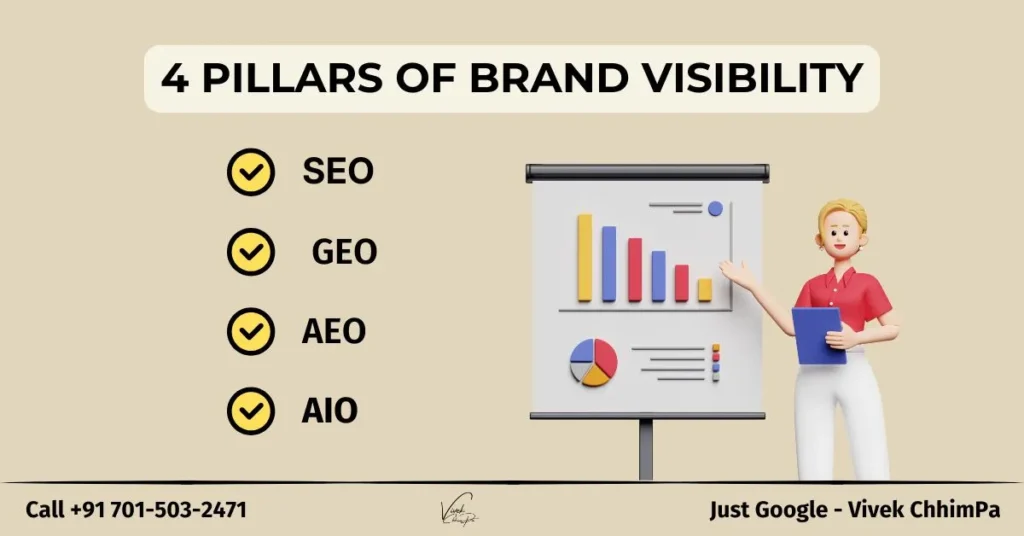
The classic three-step pipeline is no longer the entire story. We have completely transitioned out of the old era of simple keyword matching and entered the era of GEO (Generative Engine Optimization) and AEO (Answer Engine Optimization).
Modern search layers run on advanced artificial intelligence and massive semantic language models. Search engines don’t just look for literal keyword strings anymore; they read your entire site to understand context, author credentials, and topical depth.
Furthermore, users are increasingly getting direct answers from interactive AI layers like Google AI Overviews and conversational models like ChatGPT. If your website lacks precise JSON-LD structured data schema microformats embedded directly in your source code, AI search engines will bypass your brand entirely. To rank today, your content must be structured as the definitive, machine-readable answer to a user’s exact problem.
Why Sophisticated Brands Work One-on-One with Vivek Chhimpa
Winning the ranking game requires an analytical practitioner who understands the deep technical architecture behind these AI search systems:
- Diagnostic Architecture Fixes: Leveraging my paramedical background, I systematically clean up the script bottlenecks, crawl blocks, and code bloat that prevent search engines from indexing your digital assets.
- Intent-Driven Visibility Strategy: I align your website’s structural setup with high-intent transactional search terms so that your pages display precisely when buyers are ready to purchase.
- Direct, Transparent Accountability: You never deal with outsourced agency teams or smooth-talking salespeople. You work directly with me, backed by my 4+ years of full-time organic execution experience.
Stop treating your digital growth like an expensive guessing game. Turn your web presence into a technically flawless organic asset that aligns perfectly with how modern search engines think.
Schedule Your Digital Architecture Review
Ready to diagnose exactly why search engine bots are ignoring your website? Contact me directly to book your manual website audit.
- 📞 Call / WhatsApp Direct: +91 7015032471
- ✉️ Corporate Email: connect@vivekchhimpa.com