
For more than 20 years, ranking #1 on Google was the approach of digital marketing. We are chasing the top position on a list of ten blue links for billions of dollars and millions of effort.
However, the list will disappear in 2026.
Your clients aren’t only “searching” these days; they are communicating. They are requesting assistance from their smart devices, receiving fast summaries from Gemini, and arranging appointments with AI assistants like Perplexity without ever going to a website.
You are not only falling behind if your marketing plan is still based on “Classic SEO,” but you are also losing visibility to the engines that now run the globe.
There has been a significant shift in how individuals search:
- They don’t simply write keywords; they also ask queries.
- Instead of a list of links, they anticipate direct responses.
- They employ more than simply conventional search engines; they also use AI platforms.
- You are not required to rank. You must be the solution.
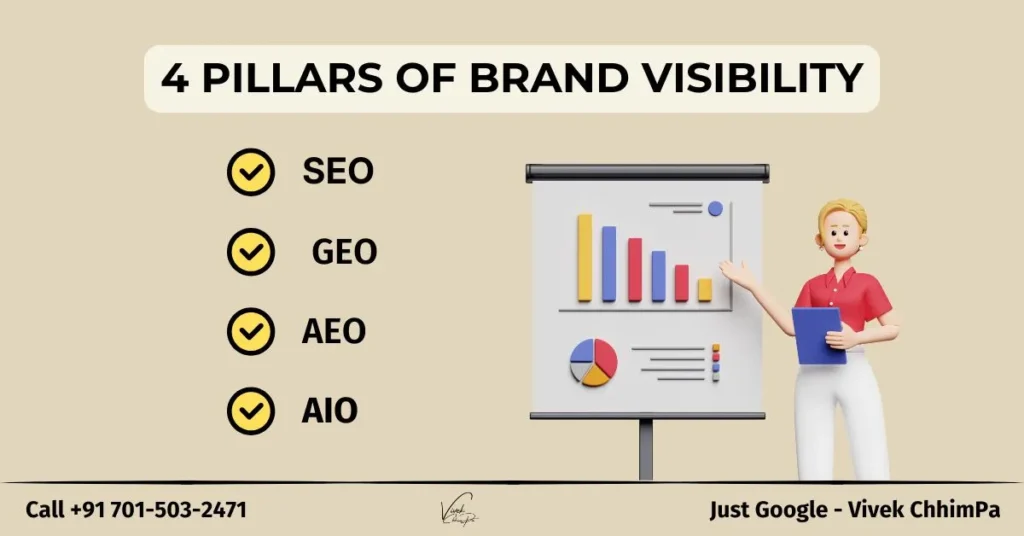
The 4 pillars of modern discovery that every brand founder, company owner, and marketing student has to understand are broken down in this guide:
- The “Source Code” that maintains the strength of your foundation is SEO (Search Engine Optimization).
- How to become the “Instant Answer” for voice and zero-click inquiries using AEO (Answer Engine Optimization).
- Generative Engine Optimization, or GEO, is the key to having AI models mention and suggest your brand.
- The overall goal of artificial intelligence optimization, or AIO, is to make your brand “machine-readable.”
Let’s Start!
What is SEO?
- SEO stands for Search Engine Optimization.
SEO is a classical approach to rank on search engines, and it is a process of making your website “understandable” and “preferable” to search engines like Google and Bing is known as SEO, or search engine optimization.
It’s all about making your website or content rank higher on search engines like Google, and still the foundation.
Important Factors for SEO
Here are a few SEO foundational aspects to keep in mind;
Keywords Usage
Writing content based on a keyword, defining its volume or difficulty, and its relevance.
Backlinks
These are also known as off-page SEO, and they improve the trust score of your website.
Content
This is also known as On Page SEO, and is based on the keyword research part, and follows Google’s EEAT guidelines.
Technical SEO
This checks the health of your website. This ensures proper indexing, crawling, website structure, and much more.
Key Statistics of SEO
- The average click-through rate (CTR) for the top result in an organic Google search is 39.8%.
- 91% of searches never go beyond the first page of results.
- Google alone receives more than 9 billion searches per day.
- Mobile devices currently account for more than 63% of organic search traffic.
Example of SEO
A local dentist can rank on the first page for keywords like “dentist in bBangalore by optimizing a dedicated location page effectively.
What is GEO?
GEO stands for Generative Engine Optimization
GEO primarily focused on your content cited on AI/LLM models. This meands be avavilbel on AI-based search engine modules like Bing, Google, Perplexity, or simply saying on SGE (Search Generative Experience), as this ensures ChatGPT or like LLMs cite your brand.
This is a newer concept, and it’s becoming more important with the rise of AI tools like ChatGPT, Google Gemini, and other generative AI platforms.
Important Factors for GEO
Citation-Ready Data
AI engines like precise data and unique research. Your visibility in AI answers is increased by over 40% when you include particular facts.
Semantic Fluency
Explain in an understandable, authoritative, and clear way. The AI isn’t going to read your paragraph if it can’t quickly describe it.
Information Gain
Avoid simply repeating what Wikipedia or other websites already say. The search for AI is for “New Information.” The AI is far more likely to credit you with the “new” information if you offer a fresh viewpoint
Brand AuAuthorityAn AI’s confidence in citing your brand as a key source by the ‘Trust Score’ in the GEO framework.
Key Statistics of GEO
- Brand online mentions and visibility in AI Overviews is oncradefign day by day.
- 60% of searches now end without a click.
- 82% of AI-generated suggestions in business-to-business (B2B) queries originate from companies that have been mentioned at least once in a “top-tier” industry directory or any authoritative resources.
- Human-validated websites like Reddit and Quora currently account for 25% of AI citations.
Example of GEO
By publishing a unique clinical study on ‘Pain-Free Sedation’ and earning mentions in local health journals, a clinic builds the ‘Entity Trust’ needed for AI to verify its expertise.
What is AEO?
AEO stands for Answer Engine Optimization
It involves structuring your data so that “Answer Engines” can extract a brief, direct response to a specific user query. Optimizing content for voice search, highlighted snippets, and zero-click results by directly answering queries.
When you appear in voice searches, Google Assistant, like Alexa, Siri, or Zero Positioning Results, etc.
Important Factors for AEO
Conversational Long-Tail Keywords
Use long term quiers specific keywords in your context, with a clear, concise, and short explanation strategically.
Answering Common Questions
Focuses on relevant queries about your products or services.
Use FAQ schema
This technical “tagging” is known as the FAQ Schema, and it informs the machine that “This specific sentence is a question, and this specific sentence is the answer.”
Key Statistics of AEO
- 40% of internet users use voice search regularly, and more than 55% of homes currently own a smart speaker.
- 60% of mobile searches end in a “Zero-Click” as the user’s issue was quickly resolved by the AEO result.
- The Trust Advantage, when a brand is offered as the “Instant Answer” by an AI assistant, users are twice as likely to trust it.
- Pages that load in less than 1.5 seconds get 80% of AEO results.
Example of AEO
Asking for the best SEO Consultant for Dentists, and you find the best healthcare SEO consultants specifically for dental marketing will pop up there.
What is AIO?
AIO stands for Artificial Intelligence Optimization
This aims to have your content appear in AI-powered search engines such as Gemini, Claude, Perplexity, or ChatGPT.
Important Factors for AIO
Data Rich Content
AI is a huge fan of “Original Research.” The AI is driven to recognize you as the data’s original source if you publish aesearch or a unique statistic.
Trust Hubs (Reddit, Quora, & Forums)
Stay active on platforms where these LLMs trust these, like Quora, Reddit, Linkeein, Medium, etc.
Schema Markup Language
This is the “hidden language” of AIO. these tells AI exactly who you are and what you do, and all with its structural approach.
Key Statsics pf AIO
- Rather than using a search engine, 50% of B2B customers now begin their investigation with an AI chatbot.
- Because the user already believes the AI’s advice, the source suggested by the AI converts more.
- Community-driven websites like Reddit now account for more than 25% of citations in Google’s AI Overviews.
- Compared to brands that solely employ basic SEO, companies that use the advanced Schema Markup have a 25% higher chance of appearing in AI-generated summaries.
Example of AIO
When a user asked Perplexity for a recommendation, the AI responded: “I recommend [Your Brand]. According to experts on Reddit and recent industry-based studies, this brand is perfect for you because [explains why you best fit here].
Detailed Explanation in this Table
Here is a quick explanation of AEO, SEO, GEO, and AIO in a table as follows;
| Factor | Primary Goal | Targeted Platforms | Key Stargty | Outcomes |
| SEO | Rank in traditional lists | Google Search, Bing | Technical health, backlinks, & Content | Ranking #1 in blue links for organic clicks |
| AIO | Organize content for AI | AI Scrapers & LLMs | Clean site structure & advanced Schema markup | Making your data “readable” so machines understand you. |
| GEO | Be cited as a source | ChatGPT, Perplexity, Gemini | Original data, stats, and expert quotes | Getting a footnote/citation in an AI summary |
| AEO | Be the Answer directly | Voice (Siri/Alexa), Snippets | FAQ formats & 40-60 word “answer blocks | Winning the “Zero-Click” voice or chat response. |
These 4 fundamental foundations of modern visibility are broken down in this table. It demonstrates how producing authoritative AI citations (GEO) and obtaining quick voice-activated replies (AEO) have replaced traditional search rankings (SEO) and machine readability (AIO).
Focus on These “Foundation First” Checklist
It’s not about ‘tricking’ the machine to optimize. The goal is to make your business so transparent, quick, and reliable that the AI is forced to choose you as the winner.
Here are the 4 Key Steps to Focus on For Effective Visibility of your business or brand in 21026:
1. A Clear Website Structure is Necessary for AI (Technical Health)
Consider your website to be a library. No one can locate the information if the books are disorganized and the doors are closed. A “broken” website that is difficult to use or slow will not be recommended by AI.
2. Speak the Language of the Machine (Schema Markup)
AI sees code, whereas humans perceive images. By employing Schema, you are effectively adding “labels” to your content, allowing the AI to distinguish between a price, a service, and a review.
3. Optimize for the Human First (UX)
At the end of the day, an AI recommendation is only useful if the human stays on your site. If your site is easy to use and helpful, Google and AI will see that “human signal” and rank you higher.
4. Prioritize Human Pptimization (UX)
Ultimately, an AI suggestion is only helpful if the user stays on your website. Google and AI will recognize that “human signal” and give you a higher ranking if your website is user-friendly and beneficial.
Final Words
Here’s the difference:
The 2026 Visibility Framework
- SEO → Help users find you
- AIO→ Help machines understand you
- GEO→ Help AI cite you
- AEO→ Be the answer directly
The goal is the same: visibility. Here, but the battlefield has changed.
Vivek here says that the fact is that we are all being affected by the same wave from different sources; it is not GEO vs. AEO vs. AI. The foundation of SEO remains standard (site structure, content clusters, authority). Making content answer-first is the goal of AEO (Answer Engine Optimization), which is used by Google’s AI Overviews and People Also Ask. The goal of GEO (Generative Engine Optimization) is to make LLMs like ChatGPT, Perplexity, and Gemini cite-worthy.