One of the most important technologies ever developed is probably Google’s search algorithm. Given that there are an estimated billion Google searches every day, it is reasonable to say that Google has an important impact on both the world and the business you run.
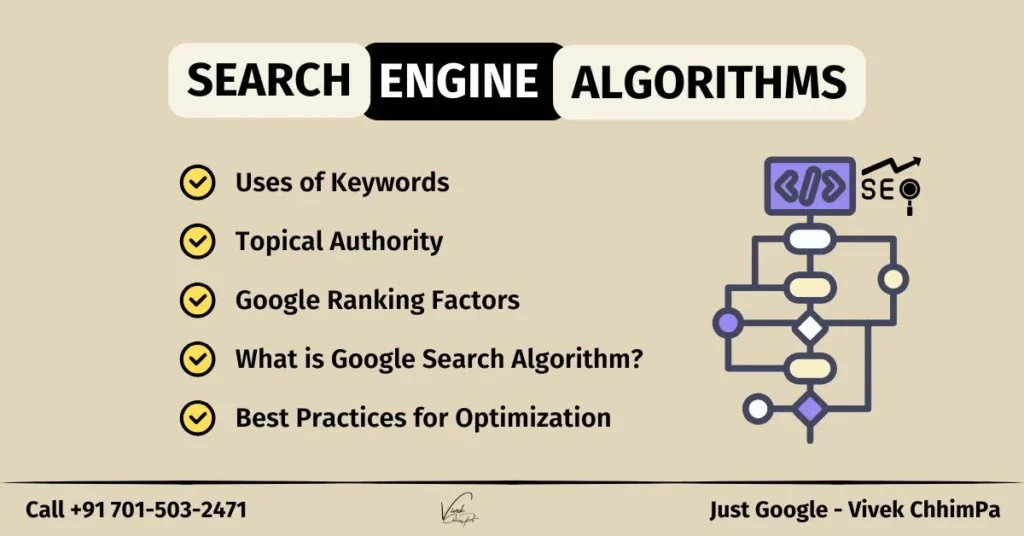
Search engines like Google and Bing use a complex set of principles called search engine algorithms to rank websites in search results based on their quality and relevancy. Giving customers the most helpful and relevant data for their search queries as soon as possible is the ultimate goal.
What is the Google Search Algorithm?
The approach that Google implements to rank data is known as the Google Search Algorithm. It considers hundreds of variables, such as backlinks, usability, and keyword appearances.
Different Ranking Factors of the Google Search Algorithm
Many variables have been employed by Google’s search algorithm to rank websites, and these elements may be generally divided into many key categories.
The focus is on giving them the most relevant, outstanding, and practical results.
Backlinks
Links from other websites to your own are referred to as backlinks, and they are an important way for search engines like Google to check your authority and authenticity. They serve as “votes of confidence,” showing that other people think the content is worth mentioning.
White-hat SEO techniques, such as creating outstanding, link-worthy content, participating in targeted guest blogging on reputable websites, and building connections through digital PR and outreach to obtain organic, editorially-placed links, are the centerpiece of strategies for obtaining successful backlinks.
Connections from reputable, industry-relevant websites are far more valuable than a large number of low-quality connections; thus, their quality and relevance are crucial. Buying links or employing link farms are examples of manipulative strategies that might result in harsh punishments from search engines.
Content Freshness
The timeliness of a webpage’s content is commonly referred to as “content freshness,” which is an important Google ranking factor, especially for queries where the user anticipates recent results (also known as “Query Deserves Freshness”). Google gives priority to newly published or updated material when it comes to time-sensitive subjects like breaking news or current product reviews.
However, earlier authoritative literature is still important for timeless subjects like historical facts. Google evaluates freshness using new user involvement signals, publication dates, and the importance of content modifications.
Instead of just changing the date without making significant changes, website administrators should concentrate on really updating current material with important information and blending timeless articles with timely content in order to successfully exploit this element.
Relevancy
One of the most important factors when deciding a webpage’s rank on a search engine results page is relevancy. The system will examine keywords and their use to estimate their relevance. The relevance of a webpage is also determined by the positioning of keywords. For example, a page is more likely to rank better if it has a keyword in both the title and the first few lines of text. The webpage will rank higher if a term is used frequently without being stuffed with keywords.
Content Frequency
While it is not a direct Google ranking factor in and of itself, content frequency describes how frequently a website releases new content. For SEO, consistency and quality are more important than quantity.
Regardless of whether the information is released daily, weekly, or monthly, Google gives priority to thorough, high-quality content that benefits consumers. While uploading low-quality material regularly can dilute subject authority and severely damage a site’s performance, a regular, controllable publication schedule tells search engines that a site is active and maintained, which can help with regular crawling and indexing.
Thus, the optimal frequency strikes a compromise between production capacity and the dedication to consistently producing worthwhile, user-focused content.
Uses of Keywords
The main purpose of keywords in search engine optimization (SEO) is to help search engines understand the content of a webpage and match it with user intent. Keywords are the specific terms and phrases that people type into search engines. Writers may find pertinent phrases with enough search traffic to direct their content strategy by performing in-depth research utilizing tools like Google Keyword Planner.
A page’s relevance signals are improved by strategically positioning these keywords organically inside important on-page components, including title tags, headers, URLs, and body content. However, the natural use of synonyms and related phrases within high-quality, accessible material is essential, and avoiding “keyword stuffing” guarantees a favorable user experience.
This is because modern search algorithms value context and semantic meaning.
User Experience
Every aspect of a user’s interaction with a website is included in user experience (UX), which is a crucial ranking criterion for search engines like Google that place a high priority on user happiness.
A good user experience tells Google that people are finding the website useful and simple to use. Fast page loading speeds (as determined by metrics like Core Web Vitals), a responsive and mobile-friendly design, simple navigation, obvious calls to action, and simply legible content with logical formatting are all essential components of a successful user experience.
In order to determine user happiness, Google especially looks at measures like dwell time (the amount of time users spend on a page) and bounce rate (the speed at which visitors depart a website). Websites that provide a smooth, effective, and entertaining experience.
Topical Authority
Instead of concentrating only on single keywords or pages, a website or content creator may position themselves as a comprehensive, go-to source of knowledge for a particular subject area or specialty. This is known as topical authority. A website exhibits expertise, authoritativeness, and trustworthiness (E-E-A-T) to search engines by regularly producing comprehensive, high-quality content that addresses all facets, subtopics, and related questions within that subject (e.g., all aspects of “organic gardening” rather than just one blog post).
This broad coverage tells Google that the website is well-versed in the subject, which improves ranks for many related search queries, boosts organic traffic, and increases domain authority overall within that niche.
Best Practices for Optimization: An Expanded View
Website owners should concentrate on adding value for consumers to comply with changing search algorithms:
Adopt E-E-A-T: Make sure that the material is produced by people who have credentials proving their knowledge and practical experience. Develop credibility with clear policies and a safe website, and establish authority with high-quality backlinks and brand mentions.
Put People-First Content First: Instead of producing material largely intended to influence search results, provide content that directly addresses user questions, is well-written, and offers distinctive value.
Optimize for Speed and Mobile: Test and enhance performance across all devices using Google tools, such as PageSpeed Insights.
Get Build Authority Naturally: Steer clear of deceptive link schemes and concentrate on obtaining high-quality backlinks from reliable sites through outstanding content and outreach.
Stay Up to Date: To adjust tactics to the most recent best practices, stay up to date on official guidelines from the Google Search Central Blog.
Last Words
The Google Search Algorithm is a complex system with many aspects, and it keeps upgrading. However, it still aims to provide the best results for a specific search term. The principles of SEO haven’t changed much since search engines originated, despite Google’s regular updates.
You can rank on the SERPs if you focus on the ranking variables you learned in this post, especially creating relevant content, properly formatted content that aligns with the search intent of your keywords, making sure your content is fresh, making sure the user experience on your website is positive, creating relevant and quality links, and much more.